

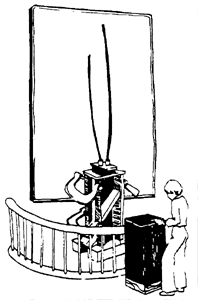
 Resonator exhibit
Drill a 1/4" hole halfway through three of the superballs, and a 3/8" hole halfway through the fourth superball. The best way to do this is to place the balls in a good vise and to drill slowly.
Place a superball on the end of each dowel. The superball adds a relatively large mass to each dowel.
The experiment will work even if you don't put superballs on the dowels, but the balls lower the resonant frequencies and make the motion easier to see. You can also substitute tennis balls or lumps of clay for the superballs. Since the center of a tennis ball is hollow, the ball tends to flop around on the end of the dowel.
Notice which dowels vibrate violently at lower frequencies and which vibrate violently at higher frequencies. CAUTION: If you get the dowels vibrating too violently-watch out!-they may break!
The same principle is at work in this demonstration. When you shake the 2 x 4 assembly at just the right frequency, a series of small shakes adds up to a large vibration of a particular dowel. The shaking board sets the dowel vibrating. If the next shake is timed just right to reinforce the next vibration of the dowel, the vibration in the dowel builds up. This process of using a series of small inputs to create a large motion is known as resonance.
The longer the dowel, the more slowly it tends to vibrate-the lower its natural frequency. Thus, the long dowel will resonate at lower frequencies than the short dowel.
Stiffer dowels have higher resonant frequencies. The 3/8" dowel is much stiffer than the 1/4" dowels, and so it tends to resonate at higher frequencies than the thinner dowels.
Each dowel may have more than one resonant frequency.
Resonance has also been responsible for some spectacular destruction. In earthquakes, buildings are often damaged when the frequency at which the ground is shaking comes very close to or matches one of the resonant frequencies of the buildings. The Tacoma Narrows Bridge vibrated itself to pieces when a strong wind pushed it at just the right frequency. The wing of the Lockheed Electra Jet failed repeatedly until engineers discovered that the wing's resonant frequency was responsible for its destruction. A suspended walkway at a Kansas City hotel collapsed when people dancing on the structure caused resonant vibration. In the army, troops always march across a bridge out of step; army vehicles are spaced at irregular intervals when crossing a bridge. These practices avoid setting up vibrations at the bridge's resonant frequency.
Not all objects resonate. Any object that dissipates energy faster than the energy is added will not resonate. Try, for example, shaking the dowels under water. The friction of the dowel moving through water will dissipate the energy faster than you add it. Since the motion of the dowel will not build up at any frequency, there is no resonance.