|
|
An Account of the Total Eclipse of the Sun on September 7, 1858, as Observed Near Olmos, Peru by Lieut. J. M. Gillis Published by the Smithsonian Institution, Washington Smithsonian Contributions to Knowledge, vol. 11 , April 1859 Starting before sunrise on the morning of the 4th we reached Olmos at 11am. Ascertaining that there was no house of public entertainment, we succeeded in obtaining permission . . . to occupy . . . the schoolhouse, and proceeded there with the equipment, until I could make inquiries respecting the road across the Andes and the climate on the summit. Our camp was erected upon a small level spot, on the northern ridge of a spur from the Andes . . . . The best ascent to it was on the eastern side, both the northern and the western being too precipitous for loaded animals. Indeed, the ascent of the western slope is almost impracticable for even pedestrians. The night of the 6th and until daylight of the morning of the 7th September was bright and faultless; but just before sunrise, a few banks of heavy cumuli formed over and near the distant mountains to the eastward, the part of the sky least obscured being in the direction of the sun. Whenever the sun became momentarily visible during that period, the cusps could not be satisfactorily seen because of the masses of vapor continuously rolling across its disk. At about 7h 15m there was a striking change; the whole mass of cumuli to the eastward was lifted towards the zenith, leaving that portion of the sky clear, and it was only by close examination that a delicate film of vapor could be detected between us and the sun. At this period, the general light did not greatly differ in intensity from that of the moon when nearly full, though its color resembled more that from burning spirit than that of the sun. At from twelve to fifteen seconds before the beginning of totality the entire lune--then perhaps 35° in extent--broke up into masses of unequal length, showing detached portions wholly separated from the rest by dark lines. The occurrence was so sudden as to startle me, and although within the ten following seconds, the remaining visible fragments had become brilliant globules of nearly equal size, they differed from Baily's beads as seen by me during the annular eclipse of September, 1838, by the darker spaces which separated them from one another .
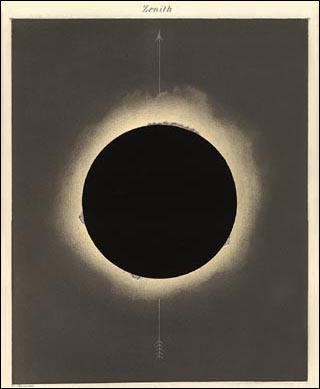
When the total obscuration took place at 7h 30m 42s .5, four masses of luminous clouds became immediately visible at as many positions of the lunar circumference. Perhaps that to the left was the first one seen, because my attention was directed there in watching the disappearance of Baily's beads, but I cannot say that they were not all simultaneously perceptible. The screen of the glass was hurriedly removed, and in the brief instant of doing so I found, to my surprise, that all the phenomena were distinctly visible to the unassisted eye. A corona light flashed out at the instant of totality. It extended farthest from the sun, in lines drawn from the centre through the solar clouds, but was nowhere traceable more than 15' or 16' beyond the lunar disk. There were no radial streamers, or bundles of rays, but only a uniformly diminishing, and slightly orange-tinted light, whose brightness and extent were apparently influenced by the mist-film, as the color of the clouds also may have been. Beyond the corona light, the color of the sky was of a grayish-black. It was a far more imposing sight without than with the telescope, and long has been my experience in the investigation of celestial phenomena, and calm and unimpassioned, at such times, as my temperament has become, the sublime majesty of the scene thrilled me with excitement and humble reverence. Nor was it less effective upon others. Two citizens of Olmos stood within a few feet of me, watching in silence, and with anxious countenances, the rapid and fearful decrease of light. They were totally ignorant that any sudden effect would follow the total obscuration of the sun. At that instant, one exclaimed, in terror--"La Gloria!" and both, I believe, fell to their knees in awe. They appreciated the resemblance of the corona to the halos with which the old masters have encircled their ideals of the heads of our Savior and the Madonna, and devoutly regarded this as a manifestation of the divine presence. Though Mr. Raymond found a candle necessary to enable him to read satisfactorily the seconds-dial of the chronometer, and the vernier-scale of the barometer, the darkness during totality could not have been very great, for my sketches were completed without the aid of artificial light. For some minutes previous, all work in the valley below us had ceased, and even the strains of martial music, which the Governor of Olmos employed to cheer laborers digging for water, two or three miles from town, were no longer audible. Superstition is still dominant here, and we hear the solemn toll of the church bell, whose sounds were intended to drive evil spirits from its vicinity. Neither at Olmos nor Piura, did any enceinte woman leave her room during the eclipse, whilst some from curiosity, but more through fear, were in the streets, yet not daring to look upon the sun, lest malady befall them. The somber green light gave them the appearance of corpses, and they apprehended that a plague might be visited upon them. Afterwards, the muleteers told us that their animals stopped eating, and huddled together in evident alarm. |
|||||||||||||||||||