|
|
A
Guide Through the Labyrinth of Memory
Memory,
a major new exhibition at the Exploratorium, will
be on view from May 22, 1998 through January 10, 1999. More than
40 new exhibits grouped into six broad areas guide visitors through
the labyrinth of memory from personal, social, cultural, psychological,
and neurological perspectives. To provide a better understanding
of the exhibition, descriptions of the thematic sections follow.
Memory
is made possible by the National Science Foundation
and sponsored by Bank of America.
Remembering
Who You Are
Every individual has unique memories--places, people, sounds, and
smells that are personally significant. In this area of the exhibition,
visitors are encouraged to share
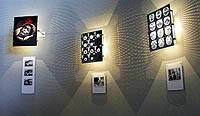 their
earliest memories, or view a display of treasured memorabilia, each
object accompanied by the story of why it's important to its owner.
A multimedia presentation will introduce you to the art of Franco
Magnani, a San Francisco resident who painted scene after scene
of his childhood home in Tuscany, all from memory.
their
earliest memories, or view a display of treasured memorabilia, each
object accompanied by the story of why it's important to its owner.
A multimedia presentation will introduce you to the art of Franco
Magnani, a San Francisco resident who painted scene after scene
of his childhood home in Tuscany, all from memory.
Sense
Memory
This area explores the evocative power of each of our five senses.
A six-minute video, Precious Images, takes you on a whirlwind journey
through the most memorable images from hundreds of your favorite
classic movies. Our "Jukebox Memories" exhibit provides
a blast from the past with the sounds of the top songs of the last
40 years. A tactile guessing game challenges you to identify some
common household objects--things you probably see every day, but
may not recognize by touch. Smell and taste are very powerful memory
stimulants. You'll get a chance to see what your brain conjures
up at the smell of baby powder, or what you can tell from the taste
of a jellybean.
Brain
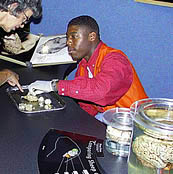 Remembering
is easy for most people. Understanding how and why we remember is
a topic that brain researchers have found to be very complex. This
area of
Memory
examines the physiological basis of memory
in the brain. See how nerve cells communicate with each other, or
watch as a sheep's brain is dissected, revealing the intricate structures
deep within. Look at tissue from a brain with Alzheimer's disease
and find out what went wrong.
Remembering
is easy for most people. Understanding how and why we remember is
a topic that brain researchers have found to be very complex. This
area of
Memory
examines the physiological basis of memory
in the brain. See how nerve cells communicate with each other, or
watch as a sheep's brain is dissected, revealing the intricate structures
deep within. Look at tissue from a brain with Alzheimer's disease
and find out what went wrong.
Remembering
Without Thinking
Memory is not always a conscious process. In this area, you'll get
to explore the ways that your brain carries memories that you may
not even be aware of. You can play "Hoop Nightmares,"
a wacky basketball game which temporarily alters your body's memory
of how to throw a ball, or find out how previous experience can
affect how you see an image.
Remembering
and Forgetting
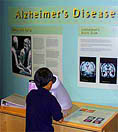 You
can learn a lot about how your memory works by seeing its shortcomings,
then learning some tricks to overcome them. This area is full of
exhibits that let you test your memory, and discover some simple
techniques to improve it. You handle hundreds of pennies every week,
but can you pick out the real penny from an array of almost lookalikes?
If you saw a face once, could you pick it out of a lineup? Discover
the differences between long-term and working memory, and between
recall and recognition.
You
can learn a lot about how your memory works by seeing its shortcomings,
then learning some tricks to overcome them. This area is full of
exhibits that let you test your memory, and discover some simple
techniques to improve it. You handle hundreds of pennies every week,
but can you pick out the real penny from an array of almost lookalikes?
If you saw a face once, could you pick it out of a lineup? Discover
the differences between long-term and working memory, and between
recall and recognition.
Shared
Memories
Some events and times are so powerful that they become shared memories--almost
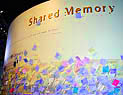 everyone
over the age of 40 remembers where they were the day that John Kennedy
was shot. This area examines the memories that span a multitude
of consciousnesses. Visitors can flash back to the most memorable
moments of this century, view a photo show of powerful and innovative
memorials, or participate in creating a time capsule to pass on
shared memories to future generations.
everyone
over the age of 40 remembers where they were the day that John Kennedy
was shot. This area examines the memories that span a multitude
of consciousnesses. Visitors can flash back to the most memorable
moments of this century, view a photo show of powerful and innovative
memorials, or participate in creating a time capsule to pass on
shared memories to future generations.
Memory
is intensely personal, intensely powerful. For each of us as individuals,
our memories establish where we've been, who we are. They are the
threads that connect our childhood selves with the adults we have
become. When we're young and don't have as much to remember, we
take our memories for granted. As our memories grow, and as we age,
they are something we fear losing.
Memory
is a new kind of
exhibition, an experiment that uses science and art from a variety
of social and cultural perspectives to help us understand ourselves.
|